San Diego, city in southwestern California and seat of San Diego County. The second largest city in California (after Los Angeles), San Diego is a port of entry on San Diego Bay and the Pacific Ocean. The city is located in a productive farm region. San Diego covers an area of about 839 sq km (324 sq mi).
POPULATION:
San Diego is one of the fastest-growing large cities in the United States. Its population grew from 875,538 in 1980 to 1,110,549 in 1990. According to the 1990 census, San Diego had one of the highest percentages of residents who had recently moved. The census also showed that whites comprise 67.1 percent of the population; people of Asian origin, 11.8 percent; blacks, 9.4 percent; and Native Americans, 0.6 percent. Hispanics, who may also be counted among other groups, represent 20.7 percent of the city's residents.
ECONOMY:
The city is a manufacturing and agricultural trade center and the transportation hub for much of southern California, parts of Arizona and New Mexico, and nearby northwestern Mexico. Major Pacific fishing fleets are based here, and the city has a large shipbuilding industry. It also is an important center for developing and manufacturing aerospace and electronic equipment. Other products include printed materials, machinery, fabricated metal products, processed food, furniture, clothing, and chemicals. The city's economy is also driven by a large United States Navy shipyard and other defense-related industries. San Diego's equable climate, its extensive sand beaches, and its many cultural attractions make it a popular retirement spot and a year-round vacation and convention center. San Diego Jack Murphy Stadium is the home of the Chargers of professional football and the Padres of professional baseball. The city is served by San Diego International Airport.
EDUCATIONAL AND CULTURAL INSTITUTIONS:
San Diego is the seat of San Diego State University (1897); the University of California-San Diego (1912), which includes the Scripps Institution of Oceanography (1903); the University of San Diego (1949); United States International University (1952); and an extensive junior college system.
San Diego's cultural activities draw millions of tourists each year. Balboa Park is a central attraction and contains the San Diego Zoo, one of the world's most extensive zoos; the San Diego Museum of Art; the Old Globe Theatre, a reproduction of Shakespeare's theater in England; Fleet Space and Science Center; the Aerospace Museum; the Natural History Museum; and the Hall of Champions, a sports museum. Elsewhere in the city are Sea World, a large oceanarium; the La Jolla Museum of Contemporary Art; and the Civic Theatre, where the San Diego Symphony Orchestra and opera and ballet companies perform. The historic Old Town district and the Gaslamp Quarter contain museums and examples of 19th-century buildings. The Cabrillo National Monument, located on Point Loma, memorializes Juan Rodríguez Cabrillo, the first European to discover the present site of San Diego. Palomar Observatory is near San Diego, in Cleveland National Forest.
HISTORY:
San Diego's excellent deepwater harbor was entered in 1542 by the Portuguese explorer Juan Rodríguez Cabrillo. Sixty years later Sebastián Vizcaíno, a Spanish navigator, visited the site of the city and named the bay either for San Diego de Alcalá (Saint Didacus) or for his flagship, the San Diego. In 1769 Spaniards led by Father Junípero Serra established California's first presidio and its first mission (restored 1931) here. A community, centered at the presidio, developed slowly, and by the early 1800s it had a small trade in furs. Commerce at the harbor increased in 1827 when San Diego began to export cattle hides to New England. In 1846 the United States gained control of the community from Mexico, and from 1850 to 1870 it was known as an important whaling center. The coming of the railroad in 1884 spurred growth, which accelerated in the 20th century, particularly after 1940, with the establishment of military installations and defense-related industries. During the 1980s the city developed Horton Plaza, a shopping and entertainment facility, and it renovated the Gaslamp Quarter.
CITY DISTRICTS:
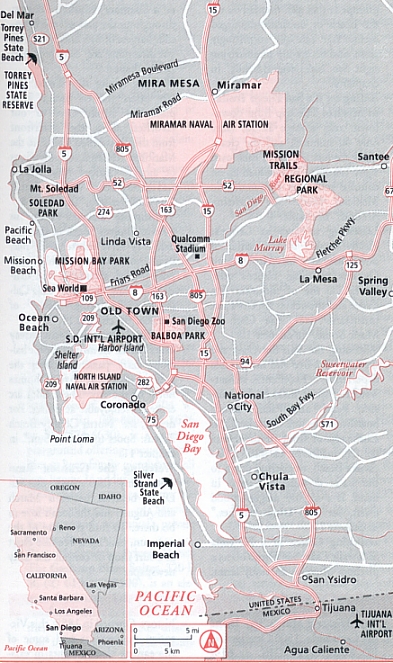
Here's a rundown on the various districts and neighborhoods of San Diego from a travel guide.
DOWNTOWN:
The business, shopping, dining, and entertainment heart of the city, the downtown area encompasses Horton Plaza, the Gaslamp Quarter, the Embarcadero (waterfront), and the Convention Center. The Maritime Museum, the downtown branch of the Museum of Contemporary Art, and the Children's Museum are also here. The Gaslamp Quarter is the center of a massive redevelopment project just recently begun in this seedy area. In the past it was a haven for drug dealers, opium smugglers, and other underworld scum. The Horton Plaza is part of this redevelopment, but some of the district is still not safe for strangers to explore. Little Italy section of town is also in this neighborhood.
HILLCREST/UPTOWN:
At the turn of the 20th century, the neighborhoods north of downtown were home to San Diego's white-collar elite (hence such sobriquets as Bankers Hill and Pill Hill, named for the areas many doctors). Hillcrest was the cities first self-contained suburb in the 1920's. Despite being next to Balboa Park (home of the San Diego Zoo and numerous museums including the Museum of Art, the Museum of Photographic Arts, and the Reuben H. Fleet Science Center) the area fell into neglect in the 60's & 70's.
OLD TOWN & MISSION VALLEY:
This area encompasses the Old Town State Historic Park, Presidio, Park, Heritage Park, and numerous museums that recall the turn of the century and the city's beginnings. There are numerous shops and eateries in this area. Not far from Old Town lies the vast suburban sprawl of Mission Valley, home to San Diego's gigantic shopping centers. Numerous hotels are in the area as well.
MISSION BAY & THE BEACHES:
Mission Bay is a watery playground perfect for water-skiing, sailing, and windsurfing. The adjacent communities of Ocean Beach, Mission Beach, and Pacific Beach are known for their wild stretches of sand, active nightlife, and casual dining. This are is the home for many single San Diegans. The boardwalk, which runs from South Mission Beach through North Mission Beach, is a popular place for in-line skating, bike riding, and watching sunsets.
LA JOLLA:
With an atmosphere that's across between Rodeo Drive and a Mediterranean Village, this seaside community is home to an inordinate number of wealthy individuals who could live anywhere. They choose La Jolla, surrounded by the beach, the University of California, San Diego, outstanding restaurants, pricey and traditional shops, and some of the world's best medical facilities. The name is a compromise between Spanish and American Indian, as it is pronounced (la hoy-ya); it has come to mean 'the jewel'.
CORONADO:
You may be tempted to think of Coronado as an island. It does have an isolated, resort ambience and is accessible only by ferry or bridge, but the city of Coronado is actually on a peninsula connected to the mainland by a narrow sand spit, the Silver Strand. The northern portion of the peninsula is home to the massive U.S. Naval Air Station. The south sector has a rich history as an elite playground and a reputation as a charming community of suburbs. Quaint shops line the main street, Orange Avenue. Coronado also has a lovely duned beach.
Here is a map of the San Diego Area: